.svg)

How one advisor matches the output of a 21-person team with 56 automated workflows and MCP




.webp)
.webp)
.webp)
.webp)




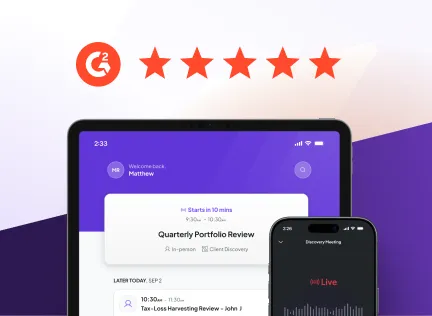
Prospera Investment Advisors: a solo practice running like a full team
Chad Heberly spent years as COO at a top-100 Ameriprise franchise with just under $1B in client assets. By most measures, that's success. But Chad wanted to build something the franchise model couldn't deliver: the experience of a family office, made available to everyday families and entrepreneurs.
So he left and started Prospera Investment Advisors from scratch. Today, Prospera is a solo practice averaging close to $1M in AUM per household, planning-first, and supported almost entirely by AI. Chad manages 24 AI agents running 56 automated workflows across 45 integrations, handling the operational work of what required a 21-person team in his prior role.
The challenge: documentation or engagement
Prospera’s clients bring complex, multi-vertical needs, including retirement planning, succession planning, business structures, investments, and insurance, often in the same household. Meetings are dense and high context, which makes documentation just as important as the conversation itself.
“My engagement could be high, or my notes could be good. Or we could have excessively long meetings to do both,” Chad says. “Those were really the three choices.”
The pain point showed up most at meeting closeout when building the packet, writing the executive summary, and updating the CRM.
Chad tested roughly a dozen tools, including Otter, Read AI, Gemini, Teams’ built-in recorder, and several AI CRMs with note-taking features. None understood financial planning conversations well enough to deliver quality notes at the level Chad expects for Prospera clients.
The solution: a standardized meeting cycle that runs itself
With Zocks, Chad found a platform that could become the operational core of his client meetings, not just creating transcripts.
Every meeting cycle is now standardized. Before a meeting, Chad drops the Zocks prep summary and supporting reports into a client folder on OneDrive, then messages his AI agent on Slack to stage everything in OneNote. (This once required a 50-page SOP and a two-page checklist.) During the meeting, Zocks captures the context, commitments, and tasks that used to compete with his attention, so he can stay fully engaged. Afterward, Chad pushes updates from Zocks into Wealthbox, HubSpot, and PreciseFP, along with saving the PDF in the client meeting folder. Those updates then flow into Income Lab via PreciseFP, while another AI agent compiles everything into one clean PDF packet and attaches it to the email generated by Zocks.
The process is the same for every meeting, and the output goes to every client, every time.
“Everything I say in that meeting, I’m sending to them,” Chad says. “Zocks is the core of bringing real transparency to those meetings.”
It also solves staying current between long review cycles. “It gets hard to remember everything,” Chad says. “I need a little refresh to remember all that stuff and what we were working on.”
MCP: Agents that talk directly to Zocks
Chad is now extending that foundation through Zocks’ MCP connection. Instead of him manually pulling or pushing data between systems, his AI agent will connect with Zocks directly, request the output, and carry it forward through the process, without the need for human action.
“APIs solved the problem of how do I get all the data from all these places into one place,” Chad says. “MCPs are solving the problem of one agent needing to hand off to the next step in the process.”
That distinction matters to how Chad designs his agent ecosystem. Rather than training his AI agents to replicate what Zocks already does well, he wants his agents to call on Zocks’ AI directly, the same way he'd bring in a specialist instead of learning their job himself.
“I don't want to circumvent that AI. I want to leverage that AI,” he says. “I'm much better off engaging the AI built for Zocks by Zocks than trying to build an agent to replicate what it's already doing anyway.”
He points to a recent case: a client with a company stock sale at retirement, nine planning scenarios, and four prior meetings’ worth of context to track. Instead of reviewing each meeting himself, Chad described what he needed to his AI agent in plain language. The agent pulled history from Zocks, gathered input from his other systems, and returned a single consolidated brief ready for the next conversation.
“MCPs help eliminate a lot of that telephone game,” Chad says. “They engage a specialist in that system to get what you've asked for in a super clean and automated fashion.”
The results: growth beyond measure
Before automation, growth meant a wall. Chad had built the practice he wanted, and referrals were coming in, but he’d hit personal capacity.
“I went from out of personal runway to continue growing without hiring someone,” Chad says, “to really feeling confident that I have plenty of personal runway now.”
That runway changed what his days look like. Instead of moving data between systems, he spends that time reading a client's relationship with money, framing recommendations around what they’re ready to hear, and catching what a spreadsheet never will.
For Chad, it all points back to the model he set out to build. “Zocks is at the core of making sure these complicated conversations get documented and transparent to the client,” he says. “Because that's really what I'm trying to execute on, bringing the family office model to scale.”
.webp)

.avif)