.svg)

Client Segmentation Strategy for Financial Advisors: How AI Can Surface Revenue Opportunities in Your Book
See how AI transforms client segmentation.

Client Segmentation Strategy for Financial Advisors: How AI Can Surface Revenue Opportunities in Your Book
An AUM-based client tier model only shows who your biggest clients are at any given time. It fails to spot who is quietly disengaging or who is about to move outside assets. While most firms already have a client segmentation strategy, traditional models remain static and don’t paint the full picture.
This operational playbook shows how to approach an AI-driven segmentation model in your practice. It covers the data it draws on, how AI identifies opportunities, the workflow changes it can trigger, and the infrastructure it requires.
Key Takeaways
- An AI-driven segmentation model transforms static AUM tiers into dynamic profiles to identify revenue opportunities.
- The system flags disengaged clients, assesses retirement readiness, and estimates wallet share to surface hidden revenue.
- Accurate segments need complete data from your CRM, planning, tax, and portfolio tools, plus the conversation data most firms miss.
What Goes into an AI-Driven Segmentation Model
An AI-driven segmentation model does not replace your AUM tiers. It adds dimensions that a single-variable model cannot capture: behavioral data, life stage and event data, and predictive signals.
AI-driven segmentation means the system updates each client's profile independently, based on current behavior, life stage, and what comes next. Much of that updating happens automatically once your full stack is connected.
Tools like Orion and Salesforce continuously run these models on every client in your book. They rely on various types of data, and conversation data is often the missing piece.
For new clients, this process begins at the intake meeting. See how it works in client onboarding.
1. Behavioral Data: What Client Actions Reveal
Behavioral data draws from four core inputs:
- Engagement score: Tracks meeting frequency, response rates, and communication patterns.
- Contribution activity: Monitors whether the client adds to or withdraws from accounts.
- Service utilization: Identifies the specific planning services the client uses.
- Digital engagement: Measures portal logins, document activity, and email responsiveness.
Two clients with identical AUM look entirely different at the behavioral level. Behavioral segmentation turns them into distinct revenue priorities.
VP of Operations Matt Welykholowa proved this concept at Thrive Wealth Management. He used Maximizer CRM to segment clients by portfolio size, service history, and financial goals simultaneously. This is behavioral segmentation in practice. He described it as the firm's "operational backbone" for delivering personalized service to every client at any stage of life.
2. Life Stage and Event Classification: Timing the Right Conversation
Life stage classification categorizes clients by their specific financial phase, such as accumulation or pre-retirement. Each life stage has different planning priorities and revenue opportunities.
Life event segmentation (marriage/divorce/retirement/inheritance) adds another layer to this process. For example, a client transitioning to active retirement triggers a retirement-readiness flag, while a client mentioning a business sale generates a money-in-motion signal. AI can uncover these milestones automatically by scanning your financial software, account data, and meeting notes.
Reaching out at the exact right moment creates a major business advantage. For instance, a retirement planning conversation should take place before a client makes permanent decisions about their government benefits. AI-driven systems can track these client milestones to ensure the meetings occur within the ideal window.
3. Predictive Signals: What the Model Sees Before the Advisor Does
Predictive signals help you anticipate what might happen in the future rather than looking at past events.
A predictive churn signal flags a client who shows signs of leaving before they take action. A client with no contributions in over 12 months and no recurring withdrawals is at high risk of churning, and AI can help you flag these clients for follow-up so you don’t lose them.
A revenue potential score predicts how much a client or segment could add to AUM under the right intervention. The system calculates this score using held-away assets, life-stage trajectory, and wallet-share gaps.
A retirement readiness flag identifies clients who are expected to retire this year with meaningful plan assets. AI can prioritize these clients for immediate income planning, Social Security strategy, and distribution sequencing conversations.
Three High-Value Opportunities AI Can Surface in Every Book
The value of a segmentation model lies in the specific opportunities it makes visible that would otherwise remain hidden in your book.
1. The Disengaged Client: Reactivation Before Attrition
AI can identify clients who have not contributed to accounts in over 12 months and surface them for a prioritized reactivation conversation. You receive a ranked list of specific clients with their engagement scores, last contact dates, and suggested reactivation actions, ordered by revenue potential score.
The goal of reactivation is not to retain an indifferent client. Instead, it's about recovering clients who drifted for operational reasons (no proactive outreach, a missed life event, slow follow-through).
While AI can rank who belongs on that list, you still know each client in a way a model never will. A quick review before reaching out keeps the outreach personal and lets you choose the right opening for someone who's been quiet for a year.
2. The Retirement Transition: The Highest-Stakes Planning Window
Retirement transitions require critical planning. You must manage income planning, a Social Security strategy, and distribution sequencing before clients make permanent choices.
AI can identity clients with a retirement date in the current year and create a segment-level opportunity report that ranks these accounts by asset size and planning complexity.
Your operations or admin team can use this report to assign staff to the highest-priority cases. Then, you guide clients through income sequencing and tax-efficient distributions.
Tools that support this work include Holistiplan for tax planning, RightCapital for goals-based income planning, and your firm's portfolio management system.
3. The Wallet Share Gap: Revenue Hidden in the Existing Book
Wallet share gaps are revenue already inside your book, just held elsewhere. AI can review conversation data, planning notes, and connected financial information to identify clients with assets outside your firm, then assign each a wallet-share estimate.
Industry estimates suggest that 20 to 40 percent of clients in a typical book hold significant assets at competing institutions. A money-in-motion signal often reveals these assets mid-conversation.
A segment-level opportunity report lists clients with estimated external asset values, the source of each flag, and a suggested next best action. You review the list, confirm accuracy, and contact clients within the right window.
Because these gaps emerge from conversation and planning data, the quality of your conversation capture directly affects the results.
How to Map Segment Assignments to Service Workflows
Segment assignments create value only when they lead to immediate actions. These actions include changing service workflows, adjusting outreach schedules, and optimizing how you and your Client Service Associates (CSAs) spend time on each client
- Service Tier Differentiation.
Service tier differentiation matches service level to segment. For example:
- Tier 1 clients with an active retirement-readiness flag move onto a proactive income-planning track.
- The model flags mass affluent clients with high engagement and growing assets for a wallet share conversation.
- Disengaged clients below a contribution threshold move into a reactivation workflow that your CSA runs, with your review first.
- Outreach Cadence by Segment.
With Outreach Cadence segments, AI-driven segmentation replaces the uniform annual review with a cadence set by each client's life stage and risk level.
For example, a client with an active money-in-motion signal gets outreach inside the conversion window, not at the next scheduled review.
- The Operations Layer as the Workflow Architect.
Your operations or admin team builds the rules that connect each segment to an action. Once those rules exist, AI can keep each client's segment current so the right workflow fires the moment their status changes, with the highest revenue potential score at the top of the queue.
The Data Foundation: What Accurate Segmentation Requires
Effective segmentation relies on the data behind it.
- Data Completeness and CRM Hygiene.
AI segmentation produces unreliable output when records are incomplete, planning data is stale, or client information sits in disconnected systems.
Most firms solve this by running a quick CRM completeness audit, confirming planning software is connected and current, and setting clear governance rules for how new client information enters the system.
- Integration Beyond the CRM.
Models that draw on CRM data alone miss behavioral and planning signals. An effective model needs to connect to planning software, tax data, portfolio management systems, and conversation-level data. Zocks captures structured conversation data from every meeting and syncs it across the advisor's full tech stack: CRM, financial planning software, tax tools, and portfolio management systems.
- Human-in-the-Loop Validation.
AI suggestions assist human judgment; they shouldn’t replace it. Firms should confirm that AI segmentation tools follow data privacy rules, including SEC, FINRA, and, where relevant, GDPR.
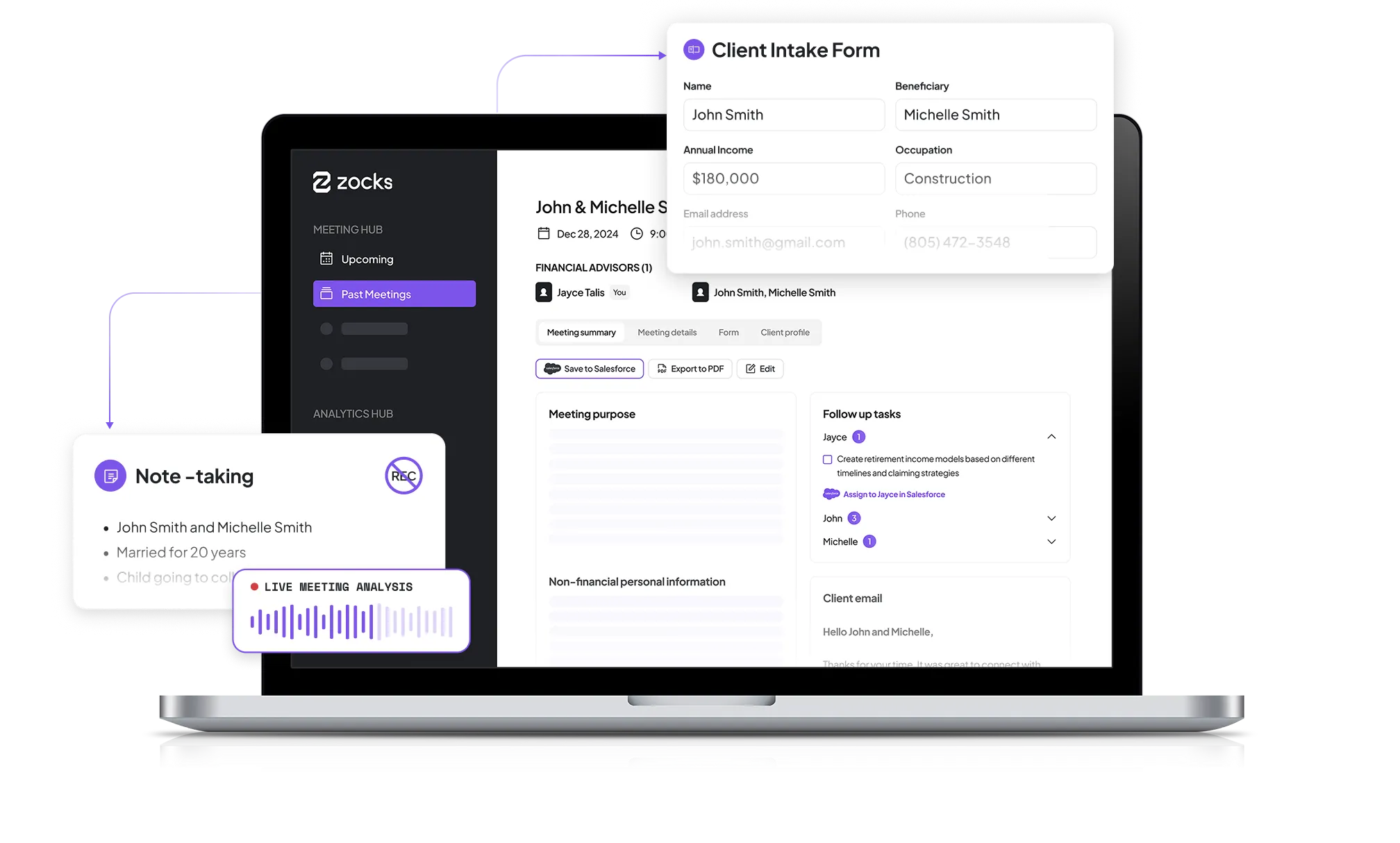
With Zocks Client Queries, uncovering growth opportunities and anticipating client needs is as simple as asking a question
Zocks captures every detail from your client conversations, emails, and documents — and connects it with your CRM and financial planning data. With Client Queries, you type a question in plain English, like “Which clients have held-away assets that we could consolidate?” or “Who needs to take their first RMD this year?” and immediately get a prioritized list of matching clients in seconds.
Client Queries changes what client segmentation looks like for advisors. Instead of spending hours cross-checking CRM records, financial planning data, and meeting notes one client at a time (or waiting for your firm to build workflows to surface what’s hiding in your book) growth opportunities and service gaps that you can solve are just one question away.
Frequently Asked Questions
What is AI-driven client segmentation for financial advisors?
AI-driven client segmentation is a dynamic, multidimensional approach to grouping clients that uses behavioral data, life-stage classification, and predictive signals alongside AUM.
Effective segmentation collects data from CRM, planning software, and conversation data, then produces updated segment profiles, engagement scores, and segment-level opportunity reports with next-best-action recommendations for each client.
How does AI identify revenue opportunities within a client book?
AI can monitor behavioral signals, life-event triggers, and financial data across all clients, then create ranked lists of opportunities with next-best-action recommendations.
The three highest-value opportunities are reactivating disengaged clients, identifying retirement readiness, and consolidating assets held elsewhere. Each opportunity is presented as a prioritized list based on its revenue potential score, rather than as a mass campaign.
What is a predictive churn signal in wealth management?
A predictive churn signal can track behavioral indicators that drop below a set threshold, such as no account contributions, declining engagement score, and reduced responsiveness. This proactive alert gives you enough time to strengthen the relationship before the client leaves.
How do segment assignments connect to advisor workflows?
Each segment assignment triggers a specific workflow: a service tier, an outreach cadence, and a set of actions for you or your CSA. Operations managers or administrative teams design these rules at the segment level, and from there, AI can keep assignments up to date so the right workflow activates automatically when a client's status changes.
What data does an AI segmentation model need to work accurately?
AI segmentation models need three inputs: current CRM records with complete client profiles, connected planning and tax software, and conversation-level data from client meetings.
Models that draw on CRM data alone produce incomplete classifications.
Conversation data is where the most valuable behavioral and life-event signals reside, and it is the source most often missing from the model.
Ask AI About this Topic
ChatGPT | Claude | Perplexity | Grok | Google AI Mode
Related blogs


Get started for free in less than 10 minutes