.svg)

How RIAs Use AI to Improve Client Service and Grow AUM
See how RIAs use AI to serve more clients, surface growth opportunities, and grow AUM without adding headcount.

How RIAs Use AI to Improve Client Service and Grow AUM
Registered Investment Advisor (RIA) clients tend to want more proactive attention from their advisors across more of their financial lives. But that attention takes time, and most advisors lose too much of it to documentation, data entry, and form-chasing.
The practical answer to how most RIAs currently use AI to improve client service and grow their assets under management (AUM) is unglamorous: AI tools absorb the administrative load, and advisors put the recovered hours back into clients and prospecting. RIA firms can then increase their AUM and client base without expanding headcount.
In fact, AI adoption is already mainstream. Schwab reports that advisor use of AI tools has more than doubled since 2023 (63% of advisors now use them) and nearly every firm would recommend it.
The five use cases below show where AI fits in an RIA practice today, which tools handle each, and how to roll them out in the right order.
Key Takeaways
- AI improves client service and grows AUM by freeing up time so advisors can spend more time with clients and prospects.
- The strongest AI use cases span five areas where, collectively, RIAs spend most of their time — often inefficiently: new client onboarding, client meetings, proactive client engagement, financial planning and tax prep, and held-away asset identification.
- Start with a tool that turns conversations into structured data, connect it to other systems that advisors use every day.
The Constraint AI Is Solving for RIAs
The biggest constraint on RIA growth sits inside the advisor's own workday. Kitces Research finds the typical financial planner spends only about 20% of working time in front of clients, while roughly 45% goes to behind-the-scenes work like meeting prep, plan analysis, and investment management. The hours that win and keep clients lose out to the hours that don't.
Cerulli reports that 83% of billion-dollar RIAs name a lack of advisor time as the top constraint on organic growth. Advisors also serve as the manual bridge between disconnected systems, updating data manually across the customer relationship management (CRM) platform, custodial feeds, planning software, and the inbox.
AI resets the advisor's role here. Instead of updating data manually, AI just does it automatically. That’s a real gain in advisor productivity because the administrative work just runs in the background (always with a human in the loop, of course). Firms then reclaim the hours clients actually pay for: judgment and building relationships.
Five Ways RIAs are Using AI Across the Advisory Workflow
AI now touches every stage of the advisory workflow, but the firms seeing real returns target specific friction points instead of buying tools at random.
1. Client Onboarding: Compressing Weeks into Days
The stretch between a client signing and their accounts funding is the most fragile window an advisor has. Every extra day of manual paperwork is another day the client can second-guess the decision, and onboarding usually stalls on missing information. Staff email back and forth, then retype everything into the custodian's account-opening forms.
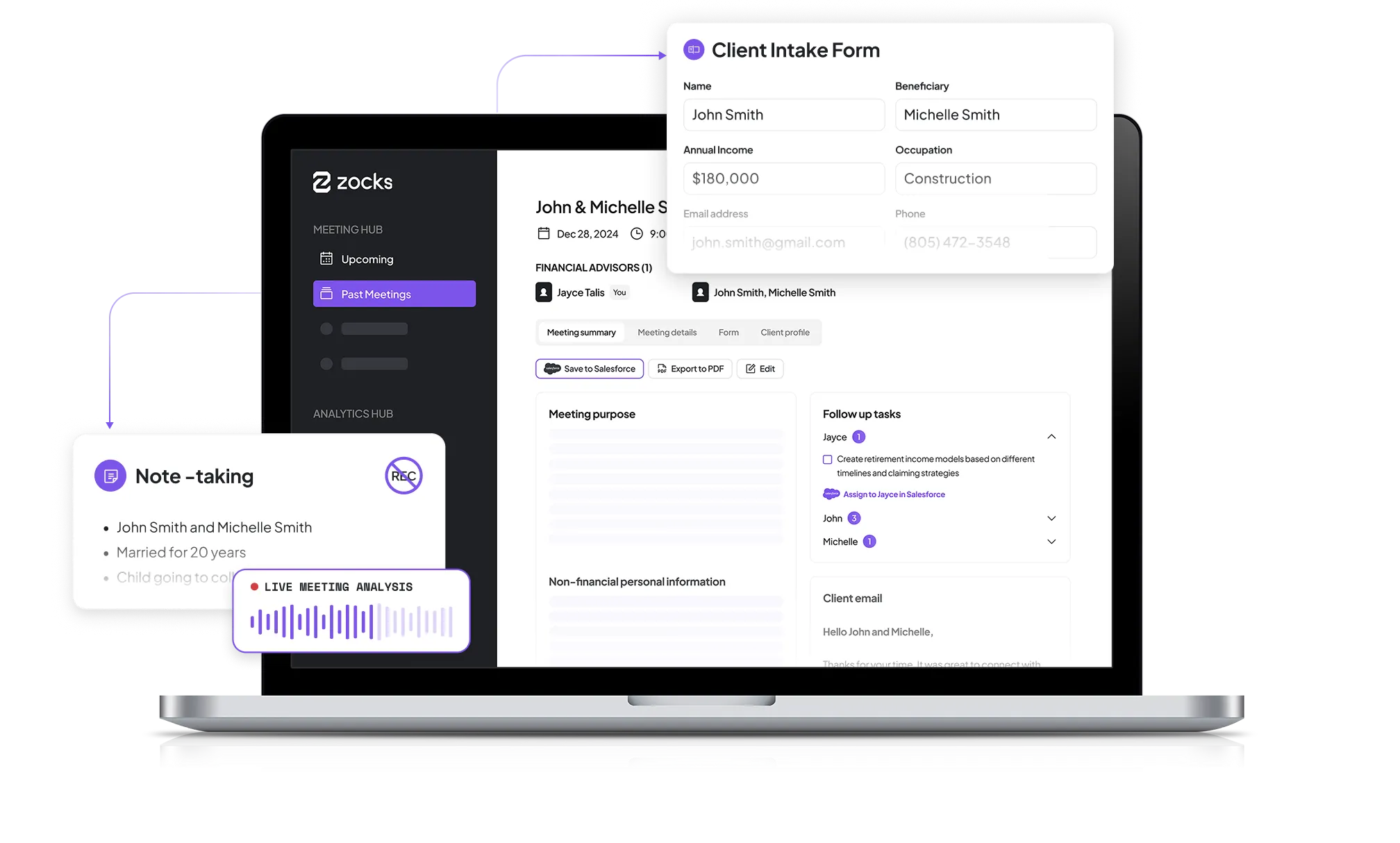
AI can fix the input side. When a new client signs on, it will automatically trigger the welcome sequencing, digital intake forms, e-signature delivery, and CRM record creation. The result is speed. Chris Arnold of Refresh Wealth reports Zocks cut his client discovery and onboarding time by 20%. Across a full book, that handles onboarding without adding operations staff to match.
2. Meeting Intelligence: From Conversation to Structured Action
Running client meetings manually comes with a cost. Advisors either type through the conversation and lose eye contact or stay present and try to rebuild the details later from memory.
But with an AI assistant, the advisor gets to have both: full attention in the room and the full meeting notes.
Zocks captures the conversation as it happens, with speaker attribution and without recording, and turns it into structured client data. Before the client leaves, Zocks drafts the meeting notes, action items, and a follow-up email, and automatically updates your CRM and financial planning tool. The advisor simply needs to review and edit.
AI delivers shadow efficiencies that improve firm capacity without changing the client-to-advisor ratio. Numbers-wise, Zocks platform data shows savings of roughly 45 minutes per meeting and 10+ hours per week.
3. Proactive Client Engagement: Acting Before the Client Calls
Most client outreach is reactive, triggered by a scheduled review or an inbound call, not by the advisor spotting a need before the client raises it. The quiet months between meetings are when clients start to feel like just another account in your book. And the signals that should trigger outreach (things like a job change, an approaching RMD, a child heading off to college, or an estate plan that hasn’t been updated in years) are buried across CRM records, financial planning tools, and meeting notes.
Zocks Client Queries lets advisors ask their entire book a question in plain English, like “Which clients mentioned an inheritance in the last six months?” or “Who has kids but no 529 plan?”
Client Queries scans their CRM, financial planning data, and every connected system to deliver an actionable client list in seconds. Advisors no longer have to build spreadsheets manually or cross-check records and meeting notes one client at a time.
That shift from reactive to proactive makes a measurable difference. A recent survey found that about 88% of clients are more likely to keep an advisor who communicates often and personally. That difference is whether that outreach is triggered by something specific in the client’s life — or just a spot on the calendar.
4. Financial Planning and Tax Output: Deepening the Advice Relationship
Tax and estate planning is where advisors are supposed to prove their value. In fact, 90% of ultra-high-net-worth (UHNW) clients expect tax and estate guidance, but unfortunately, only about a quarter say they receive it.
AI makes it operationally viable for a single advisor team to close that gap across a full book. Working from the client's own data, AI drafts the plan and tax output that an advisor would otherwise build by hand (e.g., a Roth conversion or a tax-efficient withdrawal plan), ready for the advisor to review and refine. The advisor walks into the meeting with options already on the table instead of spending that time preparing them.
Another benefit is that this lets a firm punch above its size. Smaller firms can now offer the kind of tax and estate planning that used to require a full-time specialist on staff.
5. AUM Growth: Surfacing Opportunities in the Existing Book
Your book is full of growth you just can't see yet. 20% to 40% of clients in a typical book hold significant assets at competing institutions.
A client mentions selling a business, an inheritance, or maybe a 401(k) rollover comes due. These openings can surface once in a meeting, but can be buried in a transcript that most advisors never see.
Zocks Client Queries can turn that history into a growth list. Ask where the money is moving across your book, and it surfaces held-away assets and life-event triggers in real time. Every conversation an advisor logs becomes a standing map of where the next dollar of AUM already sits.
Where to Start: Sequencing AI Adoption for Maximum ROI
Instead of buying five tools at once, sequence the rollout instead. Clean data makes integration worth doing, and proof makes the next investment easy to defend.
Start with meeting intelligence. Onboarding, planning, and client outreach all feed on conversation data, so capturing them accurately comes first.
Next, connect it to your existing stack. Link that conversation data to your CRM, planning, tax, and portfolio tools so it integrates into a single operating layer instead of disconnected point solutions.
Then measure before expanding. Track one advisor capacity metric (hours saved per week or meetings per advisor) and prove the return on investment (ROI) before adding the next layer.
See How Zocks Connects the Dots Across Your Advisory Workflow
Every use case in this article depends on one thing: knowing what your client actually said. Each filled-onboarding form or tax scenario is only as good as the conversation data behind it.
This is what Zocks does for advisors. It captures every client conversation on a privacy-first platform built for financial advisors, then turns it into the notes, emails, forms, and CRM updates that used to fill your week. Because it syncs with the tools you already run on, from Wealthbox and Redtail to eMoney and Orion, the work lands where it belongs without copy-paste.
Zocks handles the prep. You own the advice. See what 10+ hours back a week looks like.
Frequently Asked Questions
What are the most common ways RIAs use AI today?
RIAs apply AI at five points in the workflow. Onboarding automation fills out account forms based on discovery conversations. Meeting intelligence converts conversations into notes, CRM updates, and tasks.
Proactive engagement flags the clients who are worth a call. AI-assisted planning drafts tax and estate scenarios. And held-away asset identification surfaces money clients hold elsewhere in the book.
How does AI help RIAs grow AUM without adding headcount?
AI handles administrative and documentation tasks, so each advisor can manage more client relationships while maintaining the same service standard. More relationships at the same fee structure compound AUM, and the firm scales without expanding its back office in lockstep with AUM growth. One direct lever: held-away asset identification turns money clients hold elsewhere into AUM you already reach.
What is a money-in-motion signal, and how do RIAs act on it?
A money-in-motion signal is an event that puts a client's assets in play. This can be a job change, an inheritance, a property sale, or a divorce. These openings have a short conversion window, often 30 to 60 days, before the money settles.
When AI surfaces one, it recommends a next-best action, and the advisor reaches out inside that window.
What should RIAs automate first when adopting AI?
Start with meeting intelligence. Every client meeting is a built-in trigger, so adoption is simple, and the ROI shows up fast. Hours saved and better follow-through from day one.
It also generates the structured conversation data that makes every other AI use case more accurate. Sequencing is the variable that decides whether AI adoption succeeds or stalls.
How does AI improve client service quality for RIAs?
AI raises service quality, not just efficiency. It flags life events before the client raises them, so outreach feels timely. It captures structured action items from every meeting. And it briefs the advisor on what matters before each meeting, so conversations land on the right topics. A better process gives the client a clearly better experience.
Ask AI About this Topic
ChatGPT | Claude | Perplexity | Grok | Google AI Mode
Related blogs
Get started for free in less than 10 minutes